|
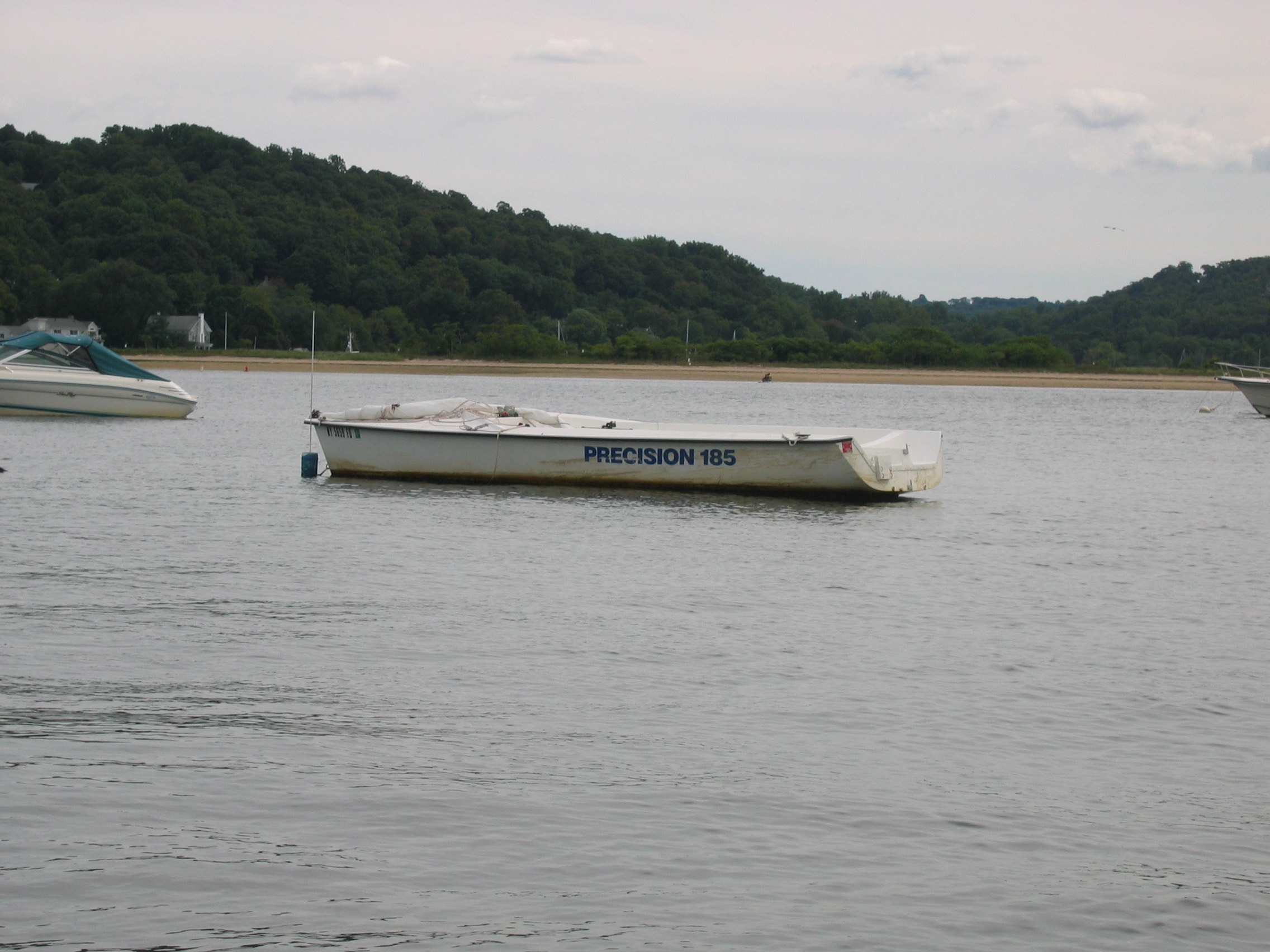
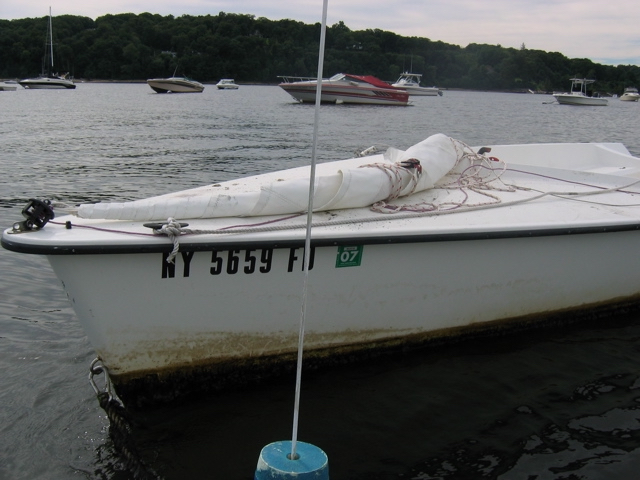
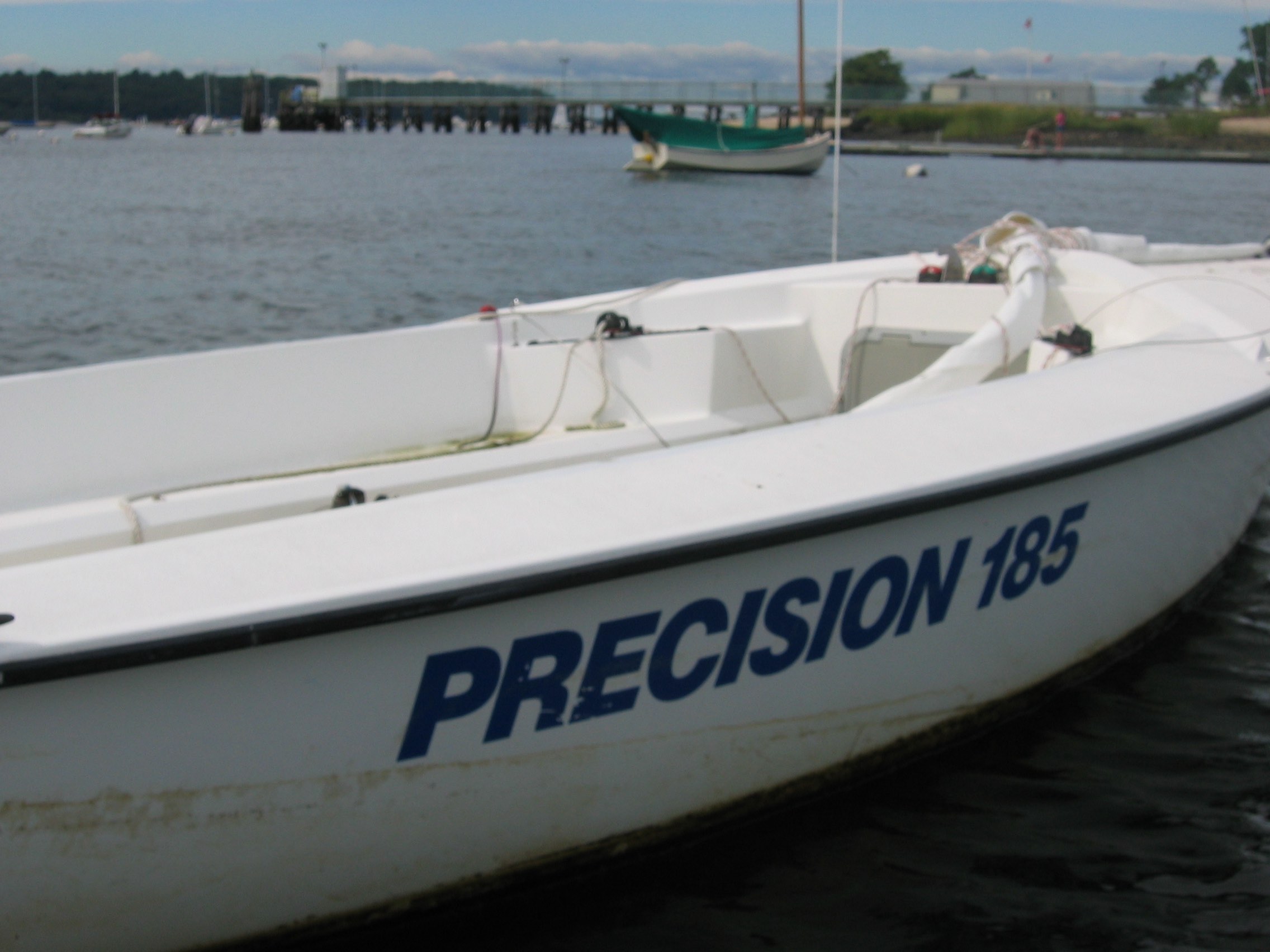
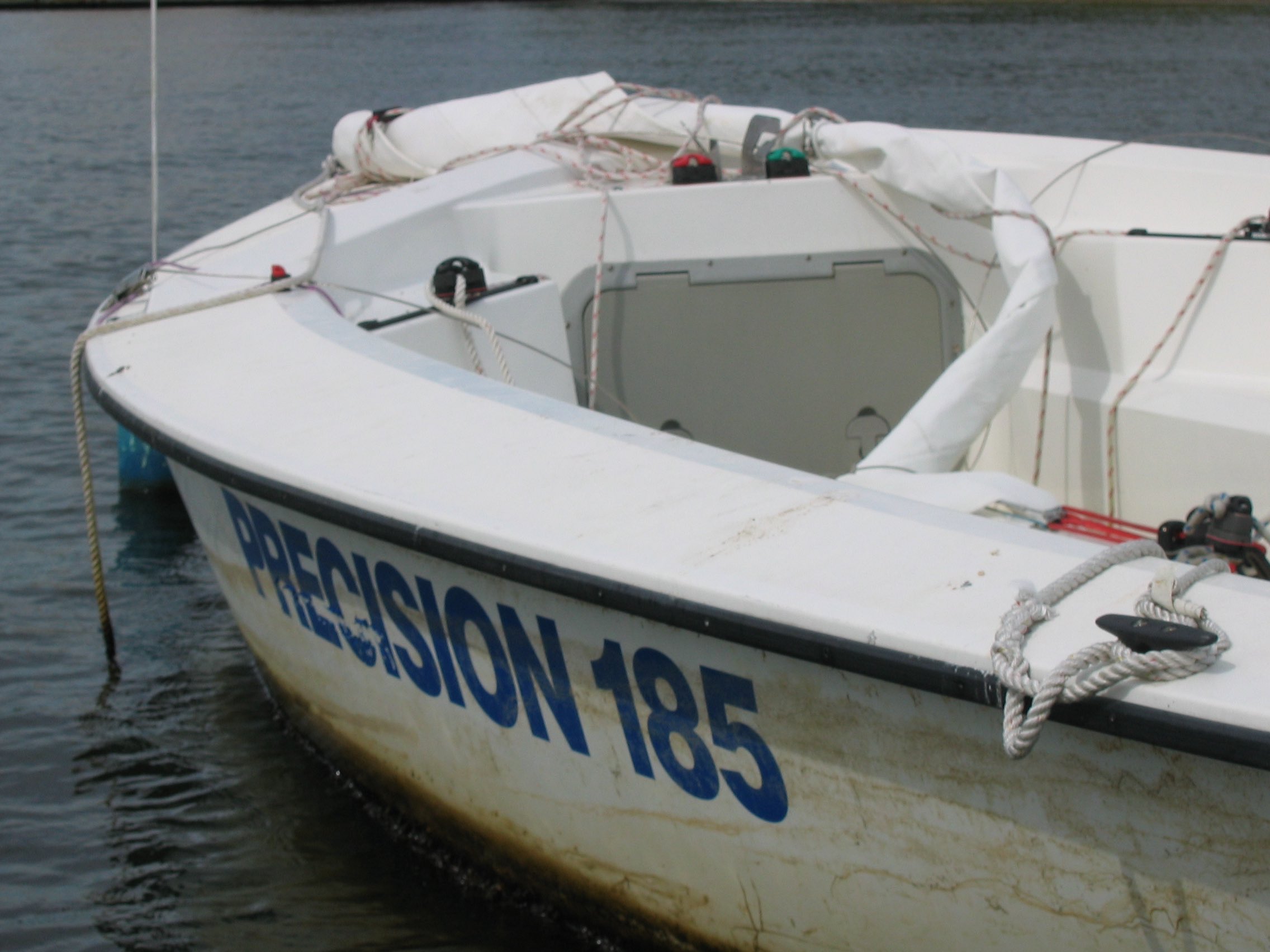
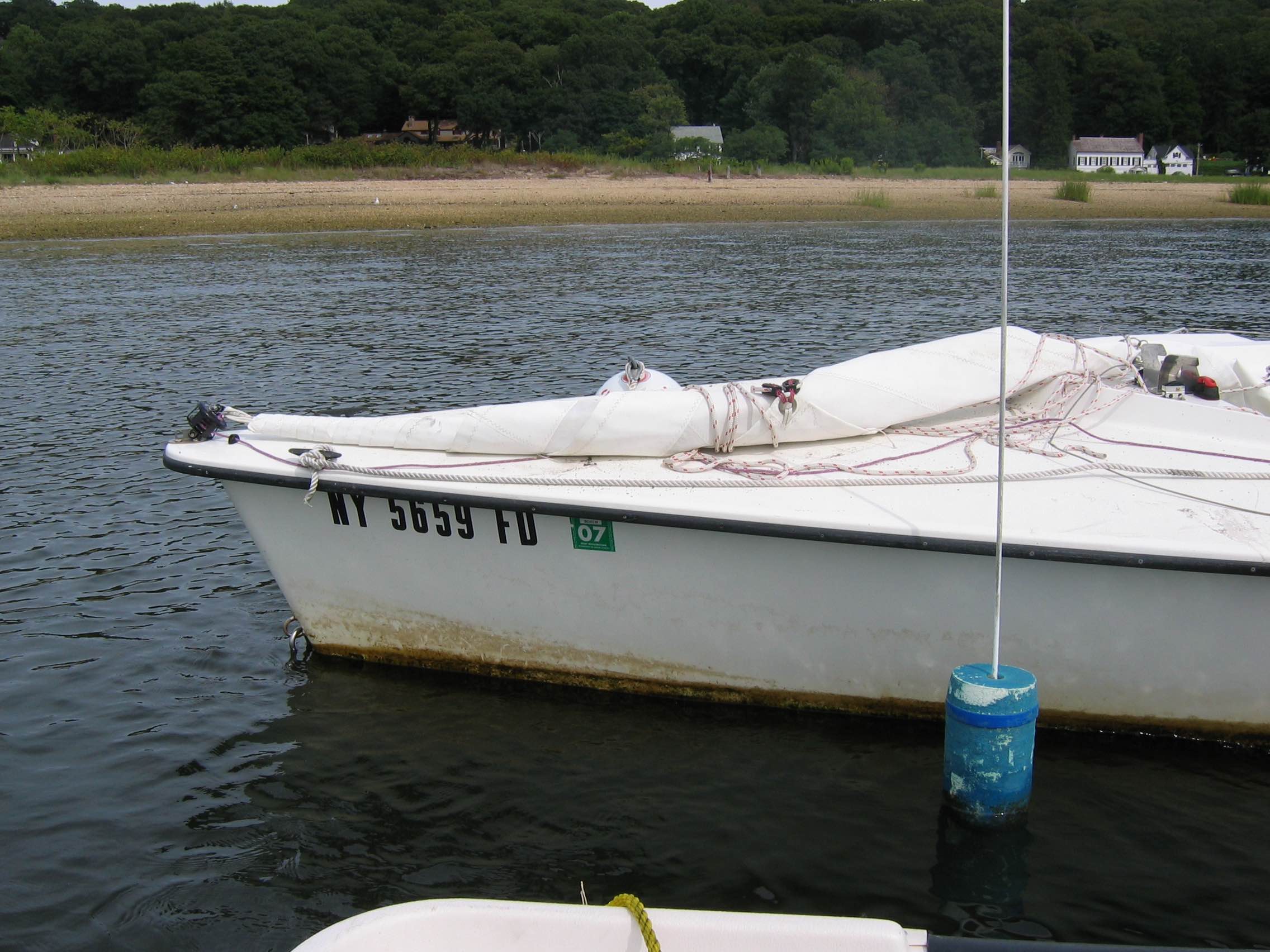
My Precision 185 CB (Centerboard Version)
THE PRECISION 185 IS ALSO OFFERED IN A KEEL VERSION. THIS WEB PAGE REFERENCES THE CENTERBOARD VERSION ONLY, WHICH IS THE VERSION THAT RECEIVED THE GLOWING SAILING WORLD'S BOAT OF THE YEAR HONORS. THE STABILITY PROBLEMS OF THE CENTERBOARD VERSION DESCRIBED BELOW ARE NOW BETTER UNDERSTOOD IN LIGHT OF ITS INDICTORS POSTED ON SAILBOATDATA.COM, WHICH REVEALS THAT THE PRECISION 185 CB HAS A HIGHER CAPSIZE RATIO THAN A SUNFISH:
- SAIL AREA/DISPLACEMENT RATIO: 35.08 (VERY HIGH)
- BALLAST/DISPLACEMENT RATIO: 0.00 (UNMEASURABLE)
- CAPSIZE SCREENING FORMULA: 3.50 (VERY HIGH. FOR COMPARISON, THE RATIO FOR A SUNFISH IS 3.23, MAKING THE SUNFISH MORE LIKELY TO RIGHT UP AFTER A CAPSIZE)
​Are you an expert sailor of lightweight centerboard boats and confident of your abilities in fresh winds and challenging conditions? Are you willing to make modifications to the design of this boat, including a float on the masthead, drill a hole through the centerboard to place a chain for retrieving the board if the boat capsizes? Are you willing to lower the mast whenever the boat is moored to prevent unattended capsizes during heavy winds? Are you able to leap quickly over the high side if and when the boat capsizes to prevent getting trapped underneath?
Then the Precision-185 centerboard sailboat may be for you.
If, on the other hand, you are a sailor of more humble abilities and are hoping the boat will provide lively and fun recreation for you and your young family, then this web site contains important information that you should read prior to considering purchasing the Precision-185 centerboard version.
This page was created to inform prospective owners regarding the potential dangers in sailing the P-185, manufactured by Precision Boat Works in Palmetto Florida. We say "potential dangers" because expert sailors have, on other forums commenting about this site, found fault with our sailing prowess, and would be completely immune from these issues that affected us. Furthermore, the expert sailors discounted other sailors' comments posted on this site in which the owners experienced nearly identical problems. If you are an expert sailor, you need read no further, since you will not encounter any safety issues with this boat. Less experienced sailors, however, take note that although the boat received accolades from Sailing World magazine, the test was conducted under unusually light winds. This boat has an inordinate tendency to capsize to an upside down position, also known as "turtling."
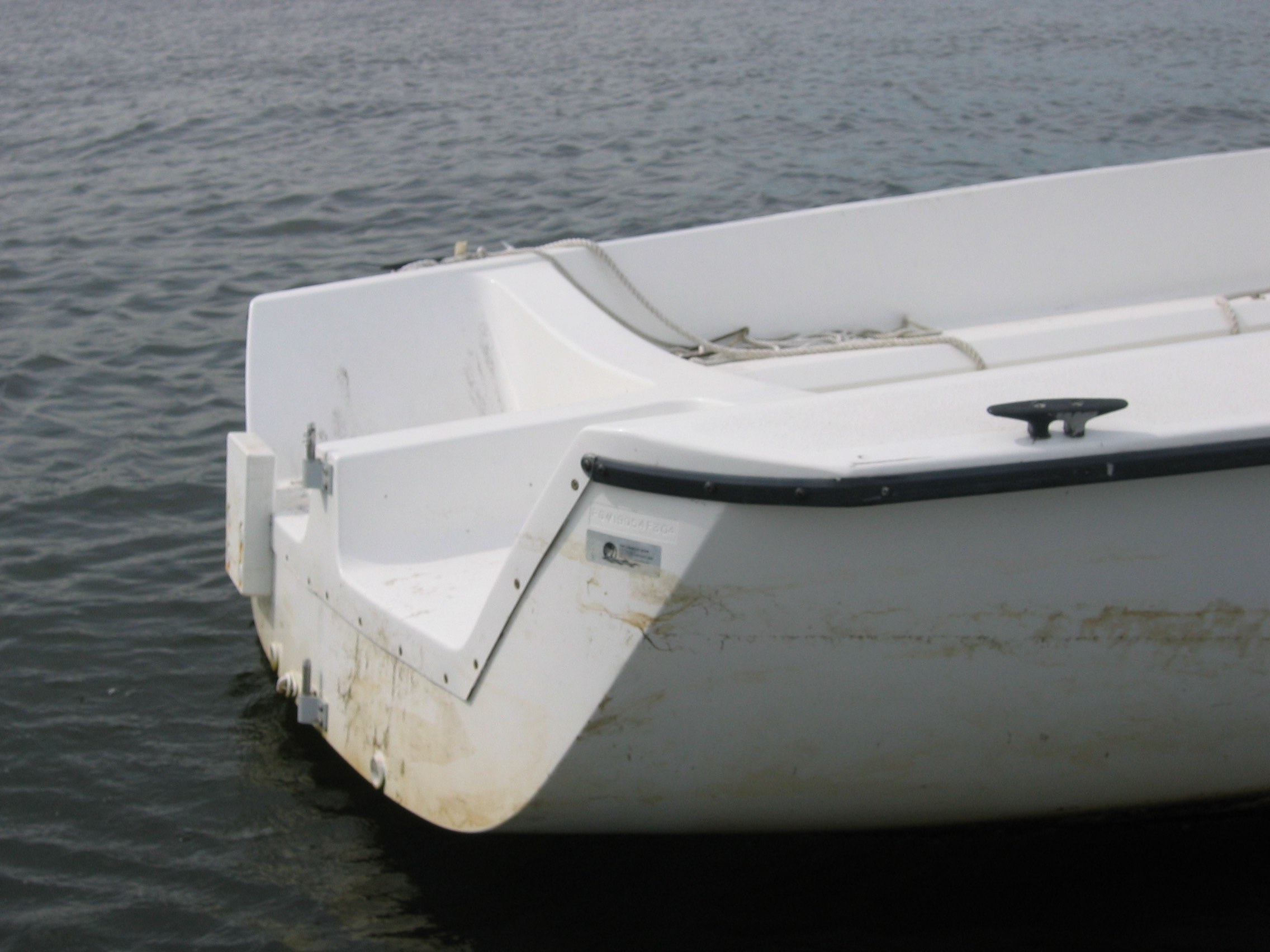
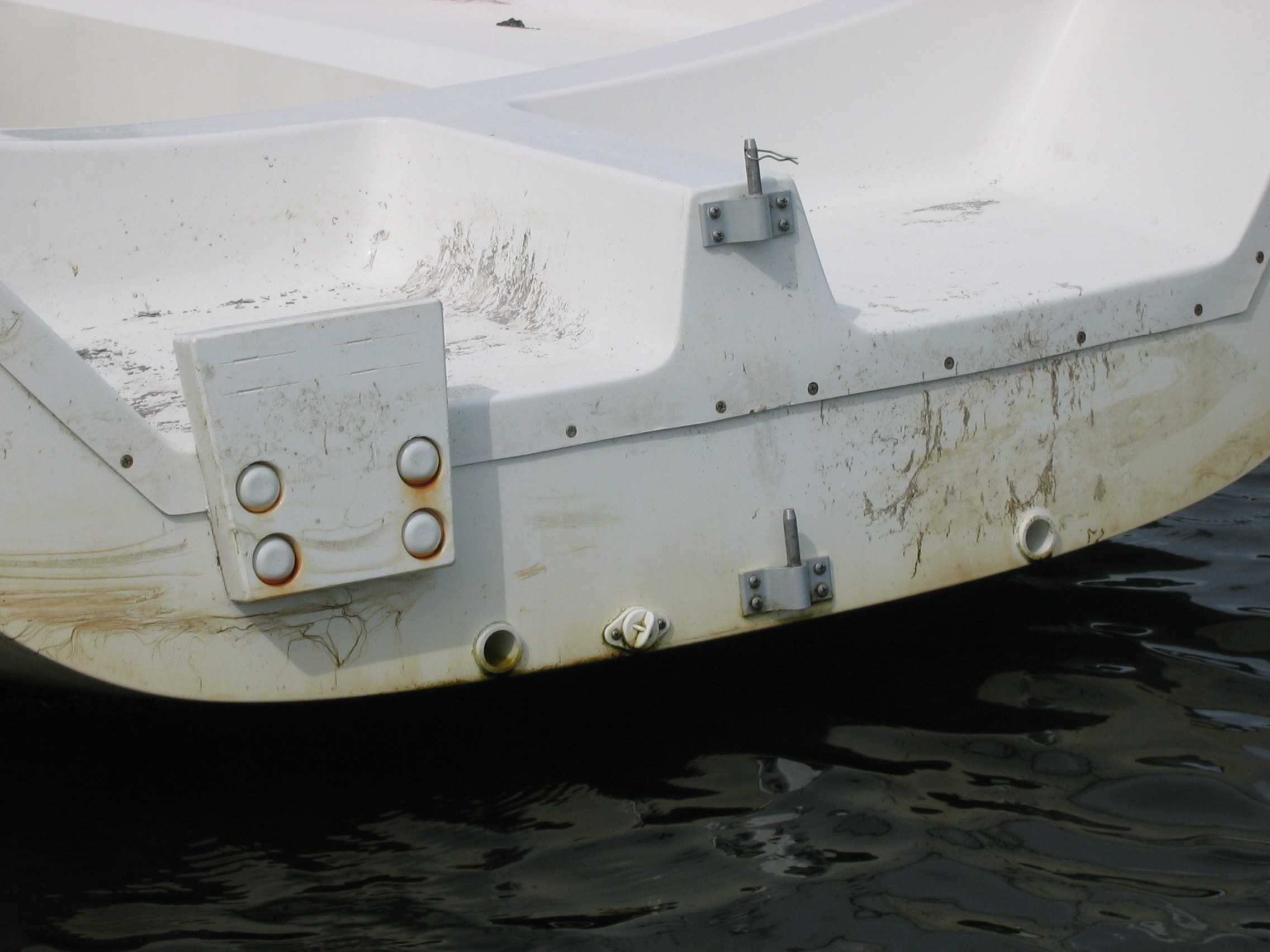
This site does not represent a personal vendetta against Precision Boat Works. On the contrary, the goal is only to inform prospective buyers of the potential hazards in winds above 15 knots. For those buyers looking for a lively, fast, retractable centerboard boat that can comfortably handle 3 adults, this boat may be for you. But before buying, be aware that despite the marketing of this boat as a "family sailboat," it weighs only 590 lbs. and acts like a racing dinghy. Unlike other dinghies, the boat does not rest perpendicularly on the water when capsizing, but instead turtles (i.e., it flips completely upside down), a likely result of a combination of factors, including a very tall mast and sail area for its size, a flat bottom, and a swiveling centerboard that disappears completely into the centerboard trunk, making it inaccessible to those in the water. Fiberglass layering on these early models may also be too heavy up top, raising the center of gravity further. The cutout on the transom, which makes for easy access from the water, is a negative once the vessel has turtled, because a safety air pocket fails to form.
For families with children and weak swimming adults take note. The time that it took the boat to progress from a 90 to a 180 degree capsize was less than 5 seconds in the situation described below. Thus, weak swimmers, can get rapidly trapped in the hull. A life preserver, which is a must in any small sailboat, can be a negative in this situation by pushing the swimmer up underneath the hull, a hull which cannot, by design, hold an air pocket.
Tragically, boating accidents claim lives every year. This boat almost cost one of us his life. In our opinion, this is a fun and lively boat for experienced sailors who are exceptionally strong swimmers and who sail in waters in which wind speeds never exceed 15 knots. It is not, in our opinion, an appropriate choice for those people looking to take children or weak swimmers on board, or who sail in less protected waters in which the wind is less predictable.
Contents:
Letter to Precision
Reply from Precision
Assessment by expert sailing writer
Letter from another P-185 owner who experienced the same problem - NEW!
Letter from yet another P-185 owner who experienced the same problem - NEW!
|
|
The following are excerpts of a letter sent to Barton Bleil at Precision Boat Works. His reply is listed below.
Dear Bart:
On the early morning of July 5, 2004, there was a thunderstorm with strong but not gale force winds. That evening, the P-185 capsized while moored. No other sailboats had either loosened from their mooring or capsized.
On Saturday, July 31st, I sailed with my 80 year-old father. The winds were Gale Force 3-4 (10-18 knots). There were no white caps on the water, but the swells were 1-2’. We sailed using only the mainsail, starting out in a broad reach with the wind coming from starboard and the board up. The winds were changing rapidly and unpredictably.
When the wind shifted again, the boat began to uncontrollably heel. I completely released the mainsheet all the way to the figure-8 knot in an effort to immediately de-power the boat. I tried to aggressively to point the bow of the boat into the wind, but by this time the tiller must have been out of the water. The boat began a slow capsize.
We both had Type III vests on and were thrown into the water.
But then things really got ugly.
Because of the near absence of compensatory hull weight, the mast and mainsail failed to hesitate on the water’s surface, instead accelerating downward once they hit the water. As the hull rapidly went from a 90 to a 180 degree capsize, I could see that my father was getting trapped underneath. In an instant, I also took note of the fact that the open transom, convenient as it is when the boat is upright, prevented a safety air bubble in the suddenly inverting cockpit. Instantly, I reached underneath, grabbed a piece of his clothing, braced my legs against the hull and yanked with strength greater than I knew was in me, and brought him out to safety.
The story has a good ending. My father, on the day before his 81st birthday, survived and was petrified but uninjured.
--------------------------------------------------------------
Sorry to learn of your sailing mishap with the boat.
Sailing dinghies with centerboard designs of all brands and sizes can and occasionally do capsize under various wind & wave conditions. They are not ballasted self-righting boats.
While I appreciate and understand your opinion, the boat was sailed by professionals and subsequently name Boat of the Year in November 2002. And Jim Taylor, our designer, has always given us well mannered boats and the 185 is no exception. He has an enviable track record of developing not only great small boats but his larger custom & production boats are wonderful designs as well. The 185 has been sailed extensively for several years and presently there are over 75 P-185's out sailing and while we have not heard from all of the owners, the ones we have heard from are enjoying the boat very much.
Best regards,
Barton
--------------------------------------------------------------
The following letter was written from a professional evaluator of sailboat design:
Thanks for your note. Most sailors like lively boats because that usually means that they're responsive to the helm and have good acceleration. But what you're describing sounds decidedly unsafe.
Now, keep in mind that I say "sounds," because no one can make such a judgment without examining a boat and testing it firsthand. I've seen Precision 185s, but I've never had the chance to play around with one on the water, so I'm not qualified to make that judgment.
I suspect that you own the centerboard version of this boat, and likely your centerboard was tucked up in the trunk when your boat turned over on the mooring. (After writing that last sentence, I then read your letter to Precision and learned that you did own the centerboard version.) Nonetheless, it is uncommon for any boat to capsize on its mooring, and doing so would likely require an uncanny combination of high winds and rough seas.
Jim Taylor is a naval architect with strong credentials, so we're surprised that a boat from his CAD system would suffer such problems, but there are always a number of factors at play when things go awry, not all of them instantly clear.
We're just speculating here, but there's a chance that the boat you bought wasn't built to the exact specifications that came from Jim Taylor, and the weight was distributed unevenly in the hull with too much of it in the upper topsides. Or perhaps the weight in the centerboard wasn't properly located. None of these possibilities can be proven now, but we'd at least expect the folks at Precision to offer you more of an explanation than what you tell us you received. Their own website pronounces that "Each boat is carefully crafted with totally hand-laminated fiberglass construction and provides excellent performance and sailing characteristics." What you've described if far from excellent.
We recommend that you send your description to both Sailing World and to Jim Taylor, and seek their comments. We'd be happy to get further involved as we think your situation merits some investigation and we wouldn't want others to have the same experience you did. However, it seems fitting that both those other parties be offered the chance to weigh in here first.
Thanks again for contacting us, and we'll look forward to being in touch with you.
(Name withheld to protect author)
--------------------------------------------------------------
Letters from another sailor who experienced similar problem with the P-185
I wish I had seen your website prior to buying our Precision 185 this past Fall. I was looking for a small sailboat in which my wife and I could safely sail our two kids (both under 5yrs old) around in. Having not been an avid sailor, I turned to my Father-in-law (avid sailor of 30+ years) to give me some advice. I think he read the review in Sailing World and believed the boat to be a good choice. We recently put the boat in the water and decided to sail it from the launch to the dock in front of my in-laws home. I enlisted the help of my Father-in-Law since I trusted his sailing capabilities more than mine. It was a bright sunny day, the wind was about 5-10 knots, nothing to worry about except for the occasional puff of stronger wind. On one particular puff, the wind caught our sail (which we did not realize the line was cleated) and when I pulled on the tiller the wrong way, the boat turtled. When I arose from the water, I completely expected us right the boat, but instead found my Father-in-Law clinging to the rudder and yelling at me to send up a flare. The boat turtled just as you described, except it wasn't completely turned over. It was at a slight angle and several hours later, after donning dive gear and lift bags, we realized that the tall mast had buried its end in the soft muddy bed. That actually saved us from being caught under the boat.
P.D.
--------------------------------------------------------------
I have enjoyed my Precision 185, but do find it touchy. However, one time I was out sailing with two other adults in strong winds, no white caps but strong winds. We caught a gust and it flipped us over and the boat promptly turtled. It was very difficult to right as it had taken a large quantity a water into the hull.
Luckily a small motor boat came along and helped us right the boat and then towed us to shore. The centerboard did disappear into the hold which made the possibility of righting the boat that much more difficult.
I have considered adding a floating bulb to the top of the mast for safety purposes, very unsightly but should reduce the likelihood of the boat turtling in the future.
I wish I had seen your website prior to buying our Precision 185 this past Fall. I was looking for a small sailboat in which my wife and I could safely sail our two kids (both under 5yrs old) around in. Having not been an avid sailor, I turned to my Father-in-law (avid sailor of 30+ years) to give me some advice. I think he read the review in Sailing World and believed the boat to be a good choice. We recently put the boat in the water and decided to sail it from the launch to the dock in front of my in-laws home. I enlisted the help of my Father-in-Law since I trusted his sailing capabilities more than mine. It was a bright sunny day, the wind was about 5-10 knots, nothing to worry about except for the occasional puff of stronger wind. On one particular puff, the wind caught our sail (which we did not realize the line was cleated) and when I pulled on the tiller the wrong way, the boat turtled. When I arose from the water, I completely expected us right the boat, but instead found my Father-in-Law clinging to the rudder and yelling at me to send up a flare. The boat turtled just as you’d described, except it wasn’t completely turned over. It was at a slight angle and several hours later, after donning dive gear and lift bags, we realized that the tall mast had buried it’s end in the soft muddy bed.—Which saved us from being caught under the boat.
P.D.
--------------------------------------------------------------
I have enjoyed my Precision 185, but do find it touchy. However, one time I was out sailing with two other adults in strong winds, no white caps but strong winds. We caught a gust and it flipped us over and the boat promptly turtled. It was very difficult to right as it had taken a large quantity a water into the hull.
Luckily a small motor boat came along and helped us right the boat and then towed us to shore. The centerboard did disappear into the hold which made the possibility of righting the boat that much more difficult.
I have considered adding a floating bulb to the top of the mast for safety purposes, very unsightly but should reduce the likelihood of the boat turtling in the future.
D.S.
--------------------------------------------------------------
If and when a boat does get suddenly overpowered by an unexpected blast, it should automatically turn itself into the wind so it will straighten up even if the skipper is asleep at the tiller.
(manufacturer of popular 22' sailboat. name withheld to protect author)
|
|